
Blackjack terms can feel like a second language when you first sit down at a table, and misunderstanding a single word can cost you a hand or a bet. Dealers, pit bosses, and experienced players toss around phrases like “hit,” “push,” “shoe,” and “true count” without slowing down, so knowing the vocabulary in advance makes the whole experience far less intimidating.
This guide walks through the essential terms in plain language, grouped by category so you can find what you need quickly. We’ll cover basic gameplay words, hand types, betting language, and some of the more advanced terms used in card counting circles. Where casino slang varies from one room to another, we’ll say so rather than pretend there’s a single universal rulebook.
Core Gameplay Terms Every Beginner Needs
Before you can follow a single hand of blackjack, you need to understand the basic actions available to you. These words appear in every rulebook, every strategy chart, and every conversation at the table, so they’re worth memorizing first.
- Hit — asking the dealer for another card.
- Stand — choosing not to take any more cards and keeping your current total.
- Double Down — doubling your original bet in exchange for exactly one more card. For a full breakdown of when this move makes sense, see our guide on what double down means in blackjack.
- Split — dividing a pair into two separate hands, each with its own bet.
- Bust — going over 21, which means an automatic loss regardless of the dealer’s hand.
- Push — a tie between player and dealer, where the original bet is returned.
- Surrender — forfeiting half your bet to give up a hand before playing it out.
These terms form the backbone of basic strategy decisions, and getting comfortable with them is the first real step toward playing with confidence instead of guessing.
Hand and Card Terminology

Once you know the actions, the next layer of vocabulary describes the cards and hands themselves. These terms show up constantly in strategy discussions and charts.
- Blackjack (or Natural) — an Ace paired with a 10-value card dealt as your first two cards, typically paying 3:2.
- Soft Hand — any hand containing an Ace counted as 11 without busting, such as Ace-6 (soft 17).
- Hard Hand — a hand with no Ace, or an Ace that must count as 1 to avoid busting.
- Pair — two cards of the same rank, which can be split into separate hands.
- Upcard — the dealer’s single face-up card, which heavily influences every strategy decision.
- Hole Card — the dealer’s face-down card, revealed only after players finish their hands.
Understanding soft versus hard hands in particular is critical, since it changes how you should play totals like 16 or 17 depending on whether an Ace is involved. Our blackjack odds guide goes deeper into how these hand types affect your long-term results.
Equipment and Table Setup Vocabulary
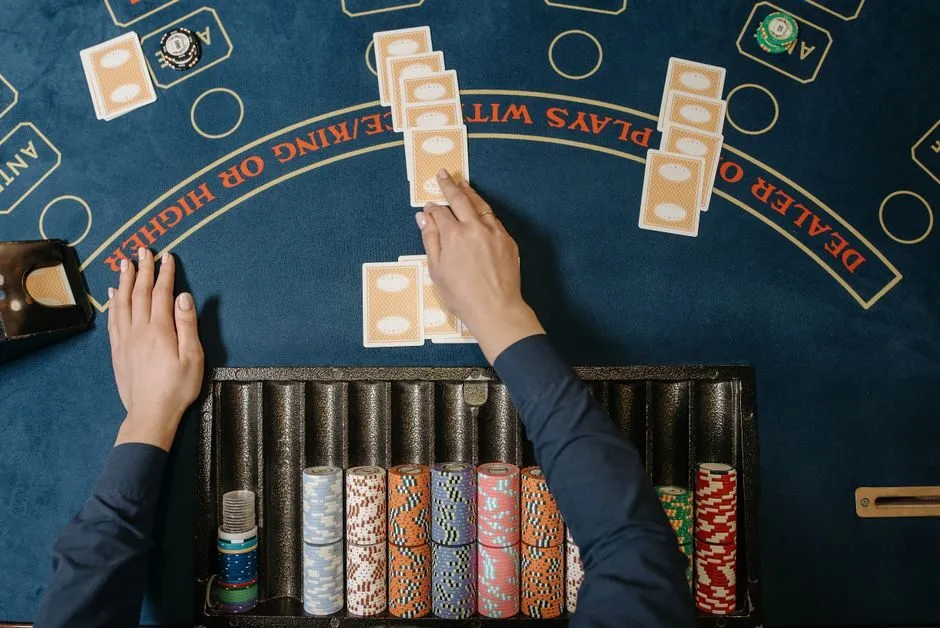
Casino tables have their own physical vocabulary, and knowing these terms helps you understand how the game is actually run on the floor.
- Shoe — the dealing device that holds multiple decks of shuffled cards, commonly four, six, or eight decks.
- Cut Card — a solid plastic card placed in the shoe to mark when the remaining cards will no longer be dealt, prompting a reshuffle.
- Discard Tray — where used cards are placed after each round.
- Felt — the betting layout on the table, printed with payout rules and betting spots.
- Pit — the area where a group of tables is supervised by a pit boss.
- Toke — a tip given to the dealer, usually placed as a side bet or handed over directly.
Table setup also affects strategy. The number of decks in the shoe, for instance, changes the house edge slightly, which is one reason serious players pay attention to game conditions before sitting down. This ties directly into the kind of card-counting deck-tracking covered in our beginner’s guide to counting cards.
Betting and Payout Language
Money moves fast at a blackjack table, and the words used to describe bets and payouts matter just as much as the cards themselves.
| Term | Meaning |
|---|---|
| Even Money | A 1:1 payout offered on a player blackjack when the dealer shows an Ace, taken instead of risking a push against a dealer blackjack. |
| Insurance | A side bet, typically half your original wager, that pays 2:1 if the dealer has blackjack. |
| Table Minimum/Maximum | The lowest and highest bets a table allows, usually posted on a sign at the table. |
| Flat Betting | Wagering the same amount on every hand regardless of the count or outcome of previous hands. |
| Spread | The range between a player’s smallest and largest bet, often discussed in advantage-play contexts. |
Casino slang for chip denominations does exist, but it varies by region and even by individual casino, so it’s worth asking a dealer or pit staff directly rather than assuming a universal standard. What’s consistent everywhere, though, is that table limits and payout rules are always posted, so you can confirm them before you sit down.
Card Counting and Advantage Play Terms
Once you move beyond basic strategy, a whole new set of vocabulary appears, mostly centered around tracking the cards that have already been played. These terms are central to the method described in our complete guide to counting cards in blackjack.
- Running Count — the ongoing tally kept by assigning point values to cards as they’re dealt.
- True Count — the running count adjusted for the number of decks remaining in the shoe, giving a more accurate picture of the deck’s composition.
- Penetration — how much of the shoe is dealt before a reshuffle; deeper penetration generally gives counters more useful information.
- Back-Counting — observing a table’s count without playing, then jumping in when conditions become favorable.
- Heat — casino staff attention directed at a player suspected of advantage play.
- Cover — behavior used to disguise counting or team play, such as varying bet sizes less predictably.
These concepts are explained step by step, including the specific point values assigned to each card, in our dedicated piece on the Hi-Lo counting system.
Dealer and Rule-Related Terms
Different casinos run slightly different rule sets, and the terminology describing these variations affects the house edge more than many players realize.
- Dealer Stands/Hits on Soft 17 — a rule specifying whether the dealer must take another card on a soft 17 (Ace-6), which changes the odds against the player.
- Blackjack Pays 3:2 (or 6:5) — the payout ratio for a natural blackjack; 3:2 is the traditional standard, while 6:5 games pay less and are generally worse for players.
- Re-Split Aces — a rule determining whether a player can split a pair of Aces a second time if another Ace appears.
- Double After Split (DAS) — permission to double down on a hand created by splitting a pair.
- No Hole Card — a format where the dealer doesn’t take a second card until after all players finish, common in some international casinos.
Reading the felt or asking the dealer about these specific rules before you play is one of the simplest ways to avoid sitting down at a table with worse odds than necessary. Small rule differences compound significantly over many hands.
Team Play and Professional Terms
For players who go beyond solo advantage play, there’s a whole layer of vocabulary borrowed from organized team efforts, including some of the strategies documented in stories about the MIT Blackjack Team.
- Spotter — a team member who counts at a table without betting large amounts, signaling a Big Player when the count turns favorable.
- Big Player (BP) — the team member who places large bets only when signaled, appearing to bet randomly to outside observers.
- Bankroll — the total pool of money a team or individual sets aside specifically for play, separate from personal funds.
- Camouflage — any technique used to make skilled play look like casual or unpredictable gambling.
- Gorilla Play — an aggressive, obvious betting style sometimes used deliberately as a cover story for a different underlying strategy.
Team-based terminology can get fairly specialized, and if you’re curious how these roles function together in practice, our piece on starting a blackjack team walks through the structure in more detail.
Quick Reference Glossary
For a fast lookup, here’s a condensed table combining many of the terms covered above. Keep in mind that some casino slang, especially around chip nicknames, varies by location, so always confirm locally rather than assuming a fixed meaning everywhere.
| Term | Short Definition |
|---|---|
| Push | Tie between player and dealer |
| Shoe | Device holding multiple decks for dealing |
| True Count | Running count adjusted for decks remaining |
| Penetration | Portion of the shoe dealt before reshuffling |
| Heat | Casino attention on a suspected advantage player |
| Soft Hand | Hand with an Ace counted as 11 |
| Surrender | Forfeiting half the bet to exit a hand early |
Bookmarking a reference like this, or printing one out, can genuinely speed up how quickly you pick up the flow of real table play.
FAQ
What's the difference between a push and a surrender?
A push is a tie, where your original bet is simply returned with no win or loss. A surrender is a choice you make before the hand plays out, giving up half your bet to avoid a likely loss. They’re unrelated outcomes triggered in completely different situations.
Why do some blackjack terms vary between casinos?
Rules like soft 17 handling, blackjack payout ratios, and re-splitting Aces are set individually by each casino, and slang for chips or bet sizes can also differ by region. It’s always worth reading the table signage or asking a dealer to confirm specifics before you sit down.
Do I need to learn card counting terms to play blackjack well?
No. Basic terms like hit, stand, double down, and split are enough to play using standard basic strategy, which already minimizes the house edge significantly. Counting terminology like running count and true count only becomes relevant if you want to pursue advantage play.
What does it mean when a dealer announces 'no hole card'?
It means the dealer won’t draw a second card until after every player has finished acting, rather than holding a hidden card from the start. This format is common in certain international casinos and slightly changes optimal strategy for doubling and splitting against a dealer Ace or 10.
Learning blackjack terms isn’t just about sounding confident at the table, it’s about understanding exactly what’s happening in every hand so you can make informed decisions. Once the vocabulary becomes second nature, concepts like basic strategy charts, counting systems, and rule variations all start to click into place much faster.